Research
Listening to the cosmos with gravitational waves
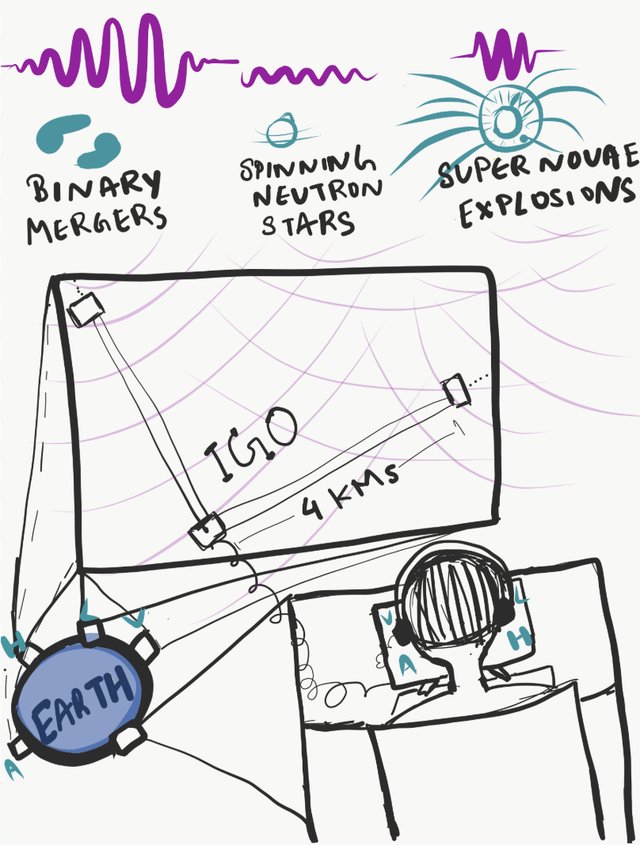
Gravitational waves are ripples in spacetime, predicted by Einstein's theory of general relativity. They are produced by violent cosmic events: merging black holes and neutron stars, spinning neutron stars and exploding stars (supernovae). A network of detectors around the world catches them: LIGO Hanford and LIGO Livingston in the USA and Virgo in Italy, with LIGO-India coming up in Aundha. Many of these signals fall in the same frequency range as human hearing, so we can turn them into sound and quite literally listen to the cosmos.
Ever since the first detection in 2015, hundreds of black hole collisions have been observed, giving insights into their formation and populations. Next-generation detectors such as the space-based LISA and the Einstein Telescope, which can probe the universe at a very early age, are already being planned.
My research focuses on gravitational lensing of gravitational waves. Just as light bends around massive galaxies, gravitational waves can be bent, magnified or even split into several copies on their way to us. I use these effects to study cosmology, the large-scale structure of the universe and alternative theories of gravity, working where mathematical and computational modeling meet data analysis and machine learning. Earlier, I also worked on COVID-19 disease modeling and nonlinear dynamics.
Positions & education
Researcher, IUCAA, Pune, India
Gravitational-wave lensing and big data analysis.
Postdoctoral Research Scientist, Max Planck Institute for Gravitational Physics (AEI), Potsdam, Germany
Astrophysical and Cosmological Relativity department, with Dr. Miguel Zumalacárregui.
PhD, Physics, ICTS-TIFR, Bengaluru, India
Thesis: Strong lensing of gravitational waves and tests of general relativity. Supervisor: Prof. Parameswaran Ajith.
BS-MS Dual Degree, Physical Sciences, IISER Kolkata, India
Dissertation: Nonlinear dynamical analysis and modeling of excitable systems. Supervisor: Prof. Soumitro Banerjee.
Memberships & honours
- LISA Consortium member since 2024.
- LIGO Scientific Collaboration member since 2020; LIGO-India Scientific Collaboration member, 2020–2023.
- DST-INSPIRE Fellowship, 2013–2018.
- AIR 23 (97.2 percentile) in JEST Physics 2018; AIR 1510 in GATE Physics 2018; AIR 5190 in IIT-JEE 2013 (top 0.3% of 1.3 million candidates).
Publications
- Across the Universe: GW231123 as a magnified and diffracted black hole mergerS. Goyal, H. Villarrubia-Rojo, M. Zumalacárregui · arXiv 2025 · Coverage: Science, AEI
- Accelerated inference of microlensed gravitational waves with machine learningM. Caldarola, S. Goyal, N. Gupte, et al. · 2025
- LensingFlow: An automated workflow for gravitational-wave lensing analysesM. Wright, J. Janquart, et al. (incl. S. Goyal) · arXiv 2025
- Fast and efficient Bayesian method to search for strongly lensed gravitational wavesA. Barsode, S. Goyal, P. Ajith · Astrophysical Journal, 2025
- Signatures of dark and baryonic structures on weakly lensed gravitational wavesG. Brando, S. Goyal, S. Savastano, H. Villarrubia-Rojo, M. Zumalacárregui · Physical Review D, 2025
- GLoW: Novel methods for wave-optics phenomena in gravitational lensingH. Villarrubia-Rojo, S. Savastano, M. Zumalacárregui, L. Choi, S. Goyal · 2024
- Probing lens-induced gravitational-wave birefringence as a test of general relativityS. Goyal, A. Vijaykumar, J. M. Ezquiaga, M. Zumalacárregui, A. K. Mehta · Physical Review D, 2023 · Explainer: Astrobites
- A rapid method for preliminary identification of subthreshold strongly lensed counterparts to superthreshold gravitational-wave eventsS. Goyal, S. J. Kapadia, J. R. Cudell, A. K. Y. Li, J. C. L. Chan · Physical Review D, 2023
- Follow-up analyses to the O3 LIGO-Virgo-KAGRA lensing searchesJ. Janquart, M. Wright, S. Goyal, et al. · MNRAS, 2023
- Search for gravitational-wave lensing signatures in the full O3 LIGO-Virgo dataLVK Collaboration · Astrophysical Journal, 2023
- The science case for LIGO-IndiaM. Saleem, J. Rana, V. Gayathri, A. Vijaykumar, S. Goyal, et al. · Classical and Quantum Gravity, 2022
- Rapid identification of strongly lensed gravitational-wave events with machine learningS. Goyal, Harikrishnan D., S. J. Kapadia, P. Ajith · Physical Review D, 2021
- Tests of general relativity with GWTC-3LVK Collaboration · 2021
- Search for lensing signatures in the gravitational-wave observations from the first half of LIGO-Virgo's third observing runLVK Collaboration · Astrophysical Journal, 2021
- COVID-19: Analysis of a modified SEIR model, a comparison of different intervention strategies and projections for IndiaA. Das, A. Dhar, S. Goyal, A. Kundu, S. Pandey · Chaos, Solitons & Fractals, 2021
- Testing the nature of gravitational-wave polarizations using strongly lensed signalsS. Goyal, K. Haris, A. K. Mehta, P. Ajith · Physical Review D, 2020
Selected talks
- Probing dark and baryonic structures with weakly lensed gravitational wavesInvited talk, Lensing and Wave Optics in Strong Gravity, Erwin Schrödinger Institute, Vienna · Dec 2024
- Rapid methods to search for strongly lensed gravitational wavesInvited talk, Multi-messenger Lensing meeting, Royal Astronomical Society, Manchester, UK · Mar 2024
- Probing gravitational-wave birefringence as a test of general relativity using GWTC-3Contributed talk, Young Astronomers' Meet, ARIES Nainital · Nov 2022; posters at IAGRG, IISER Kolkata and GWPAW, Melbourne · Dec 2022
- Strong lensing of gravitational wavesInvited talk, Jain University, Bengaluru · Apr 2022
- Rapid identification of strong lensing signals with machine learningSeminar, University of Liège, Belgium · Feb 2022
- Search for lensing signatures in gravitational-wave observationsInvited talk, CSGC · Jan 2022; GWPAW, Hannover, Germany · Dec 2021
- Advent of testing general relativity and gravitational wavesInvited webinar, Researcher on Web · Mar 2021
- Constraining polarisations of gravitational waves using strongly lensed signalsContributed talk, ICGC, IISER Mohali · Dec 2019
Recordings are on the Others page.
Teaching & mentoring
- Mentored a visiting undergraduate summer student at AEI Potsdam (2024) and ICTS long-term visiting students (2020, 2021), including work on identifying strong lensing with machine learning.
- Tutor, compact binary coalescence course, Gravitational Waves Summer School, ICTS Bengaluru (2022).
- Mentor and local study-hub host, Gravitational Wave Open Data Workshops (2021, 2022).
- Organiser and tutor, LIGO-India Continuous Gravitational Waves Workshop (2021).
- Tutor, "Light and Beyond" undergraduate summer course, ICTS (2021); Physics-I, IISER Kolkata (2017).